What the builder does
Most research advice tells you to find a gap in the literature and stops there. The Research Proposal Builder does that part with you: it reads the research PhysioKeys holds on your topic, shows you where the evidence actually runs out, and turns the gap you pick into a proposal draft — with the studies behind it attached.
Every gap it offers carries its receipts: which studies it came from, what those studies said in their own words, and the date it re-checked PubMed to see whether anything had answered the question since. That is the difference between this and asking a general AI assistant for a research topic, which will describe a gap just as confidently whether or not one exists.
It is built for the work students and clinicians are actually asked to do: a final-year project, an MSc dissertation, a PhD programme, or a service evaluation you want to run properly.
Start from your own topic
You need a subject to start, not a question. Anything from shoulder pain to a full question works, and the builder narrows it with you.
If you do not have one yet, start from the clinical question you keep running into — the one where you have never been sure the evidence settles it. If you would rather browse, the research topic generator lists areas across musculoskeletal, neurology, sports, paediatric, geriatric, manual therapy and service delivery, and each one opens the builder with that area filled in.
The five steps
The whole route, from a subject to a draft you can edit:
- Describe your research area. Open the Research Proposal Builder and describe the area you want to study, from a single phrase to a full question. Say who you are, where you could run a study, how long you have and who could take part. Nothing is searched or charged until you start the gap search yourself.
- Find the gaps. Select Find research gaps. PhysioKeys searches its research library, reads the studies it finds, extracts candidate gaps, runs a fresh PubMed check on each one, and ranks what survives. It takes a few minutes and the progress is shown as it goes.
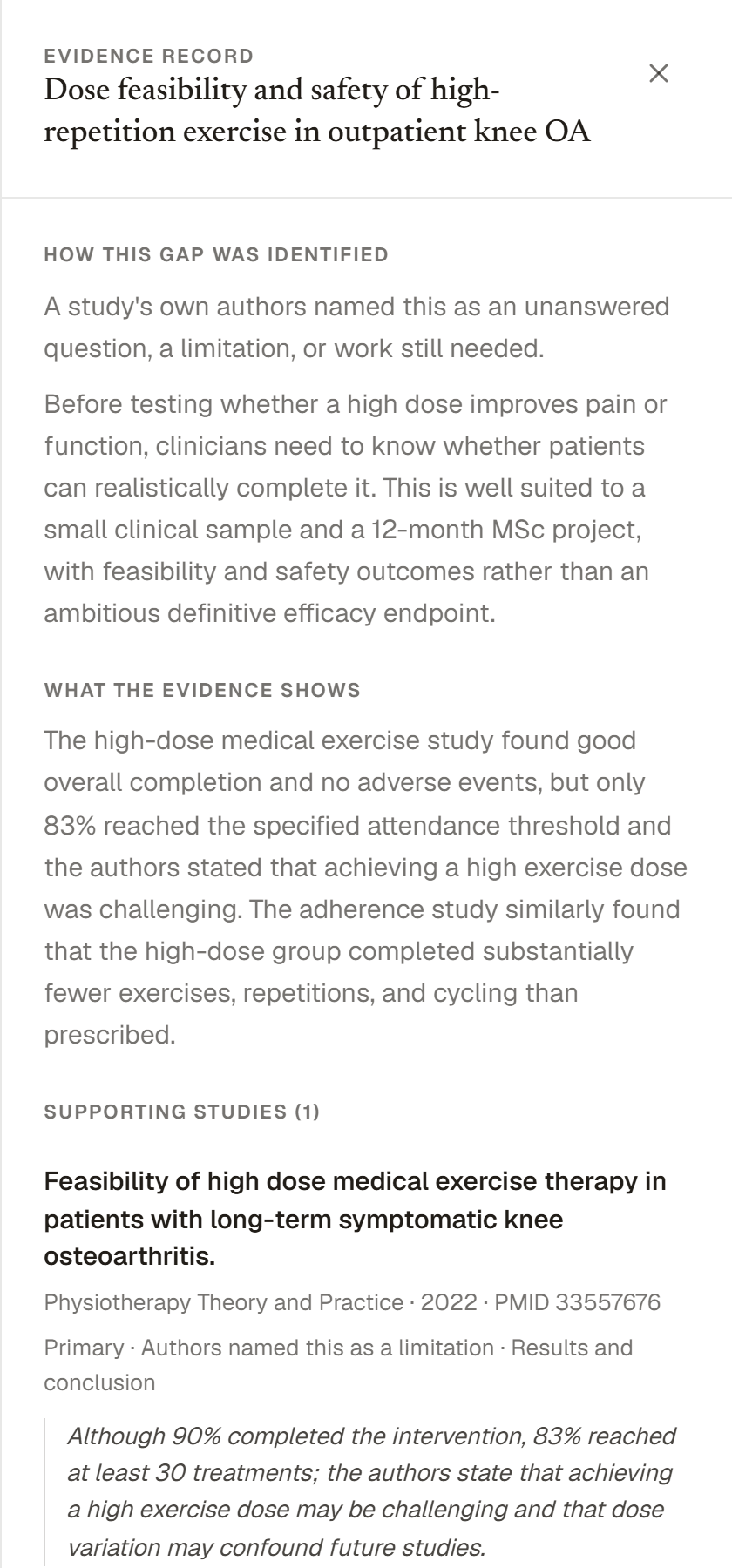
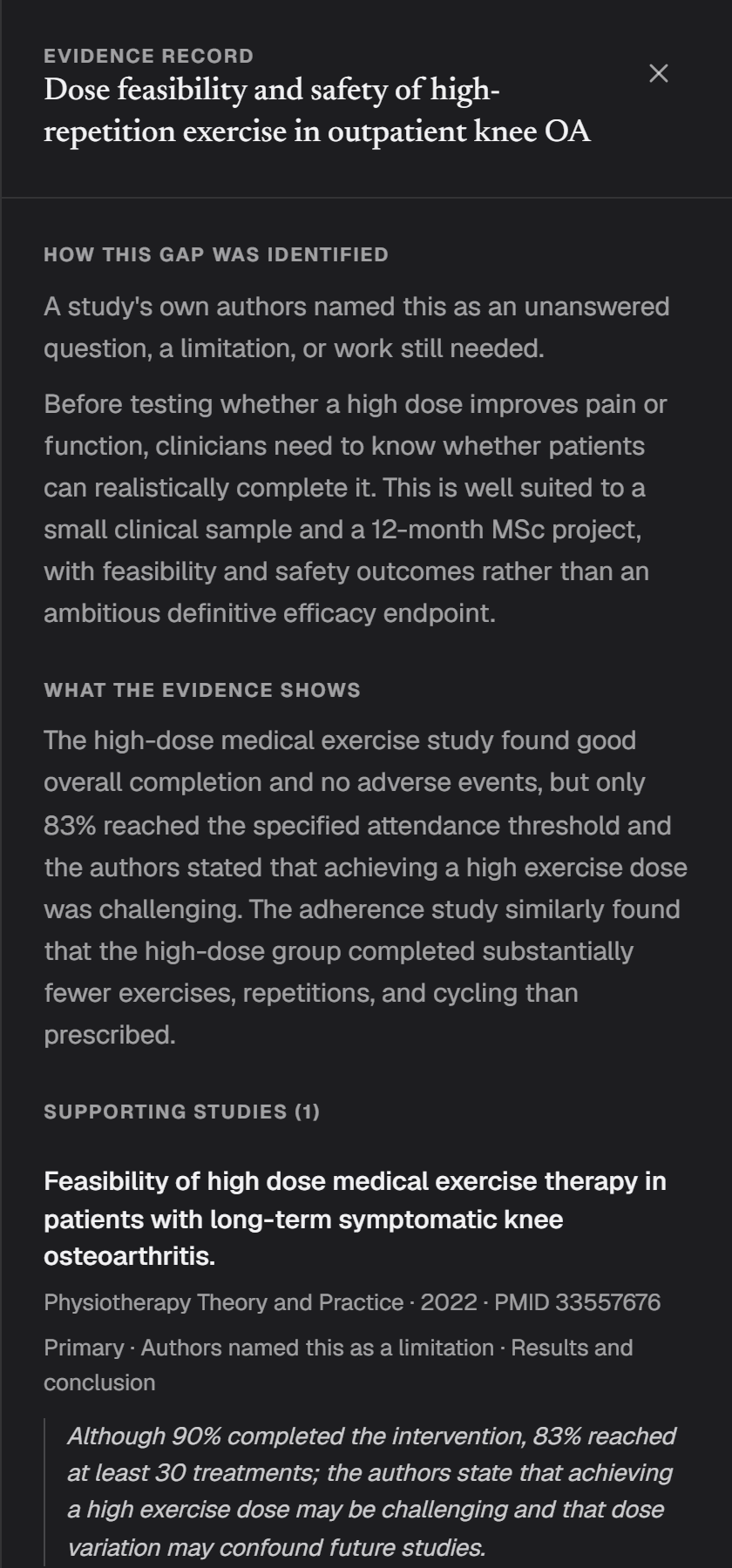
- Read the evidence behind each gap. Every gap arrives labelled as an author-stated gap, an AI-inferred gap or conflicting evidence, with the studies it came from, the passage that supports it, and the date its PubMed check ran. Open the evidence record to read those sources before you trust the gap.
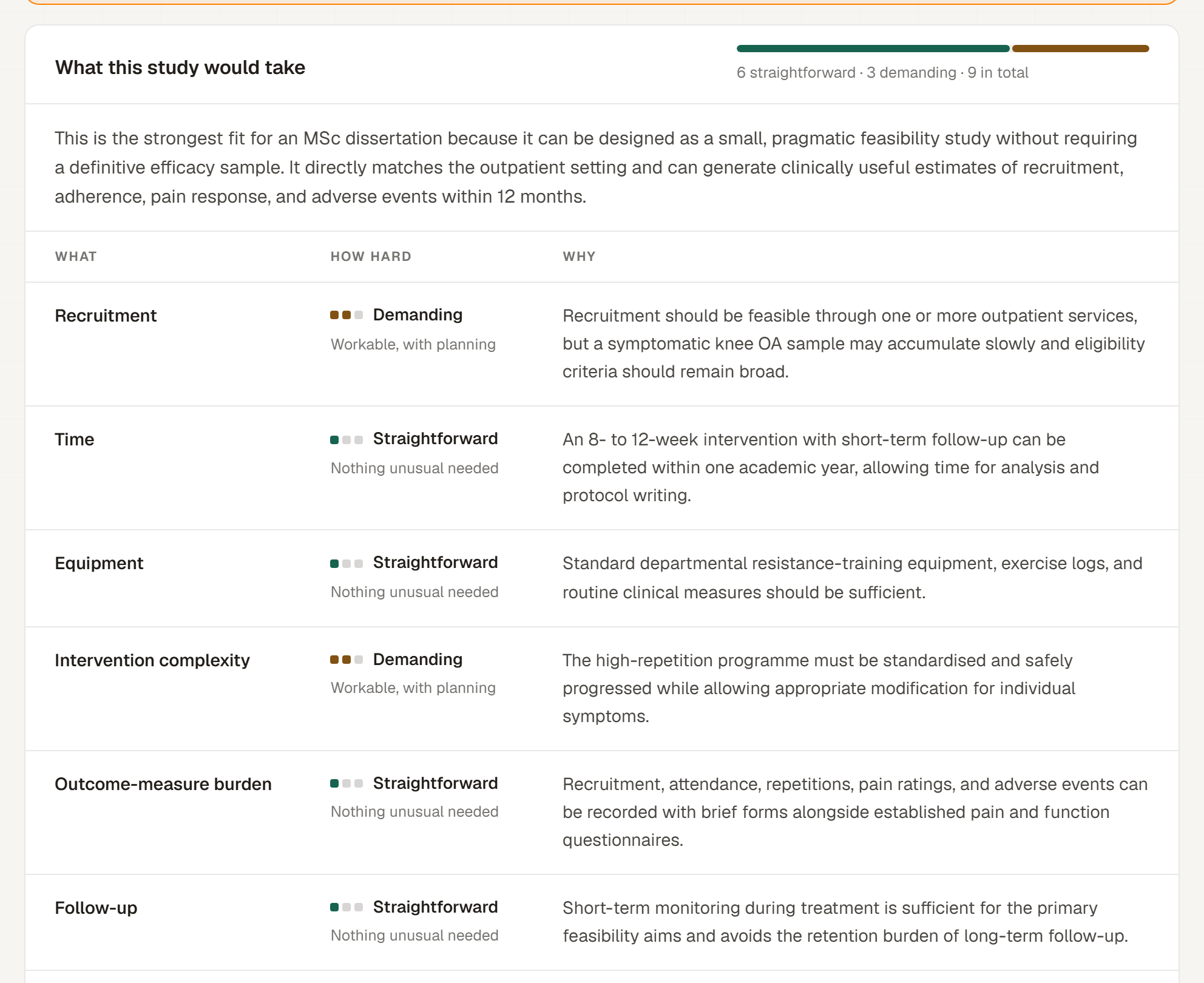
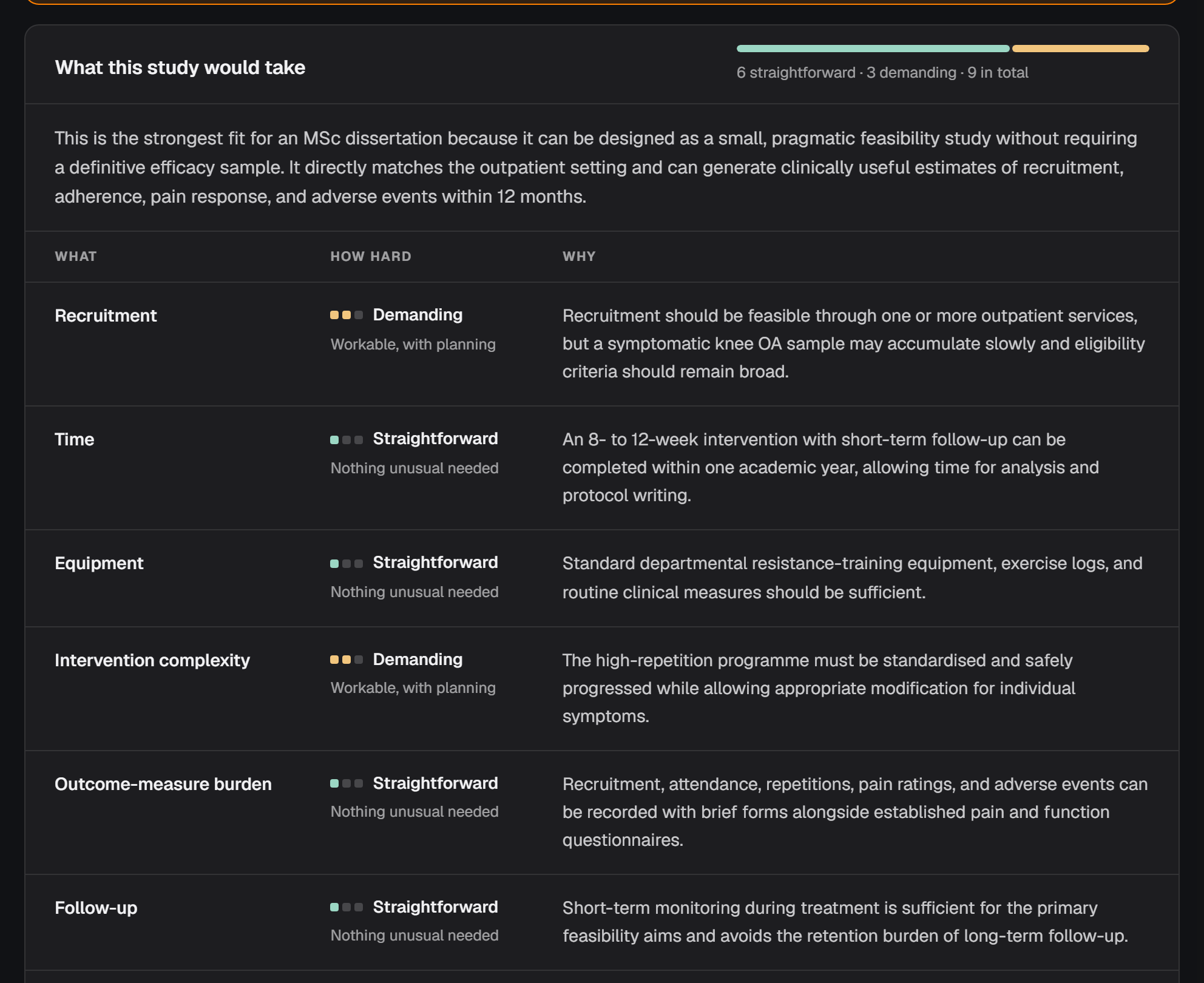
- Choose one and check it is feasible. Select the gap you want and read the feasibility view, which sets out what the study would take by dimension for your level, your setting and the participants you can reach, and names the hard part.
- Generate the proposal and keep editing. Generate the proposal at the depth you chose: gap ideas only, a structured outline, or a complete draft with its references. Send it to the PhysioKeys Notebook to keep editing, then export it to Word or PDF for your supervisor.
The rail at the top of the builder shows where you are, and a project waits for you: you can close the tab after the gaps arrive and come back to choose one later.
Tell it who you are and what you can run
The setup form is short, and every answer changes what you get back. The only one it cannot do without is the research area.
| You are | What changes |
|---|---|
| Undergraduate student | Smaller scope, simpler analysis, terms explained |
| MSc student | A full protocol at dissertation scale |
| PhD researcher | Programme-level depth and methodological detail |
| Clinician or clinical researcher | Service-compatible designs and practical recruitment |
| I'm not sure yet | A balanced draft you can narrow later |
Then the practical limits, which decide what it is allowed to suggest: Where would you run it? (University or academic department, Outpatient physiotherapy clinic, Hospital or inpatient rehabilitation, Community or home-based service, Sports club or performance centre, Private practice, Remote or online delivery), How long do you have? (Up to 3 months, Around 6 months, Around 12 months, Two years or more), and Who could take part? (No participant access, Healthy volunteers only, A small clinical caseload (under 30), A larger clinical caseload (30+), Existing data or records only).
Any preferred study design? is yours to set or to leave alone — Randomised controlled trial, Feasibility or pilot study, Cohort or longitudinal study, Cross-sectional study, Qualitative study, Mixed methods, Systematic review, Case series or single-case design — and leaving it unset asks PhysioKeys to suggest one that fits what you said you can do.
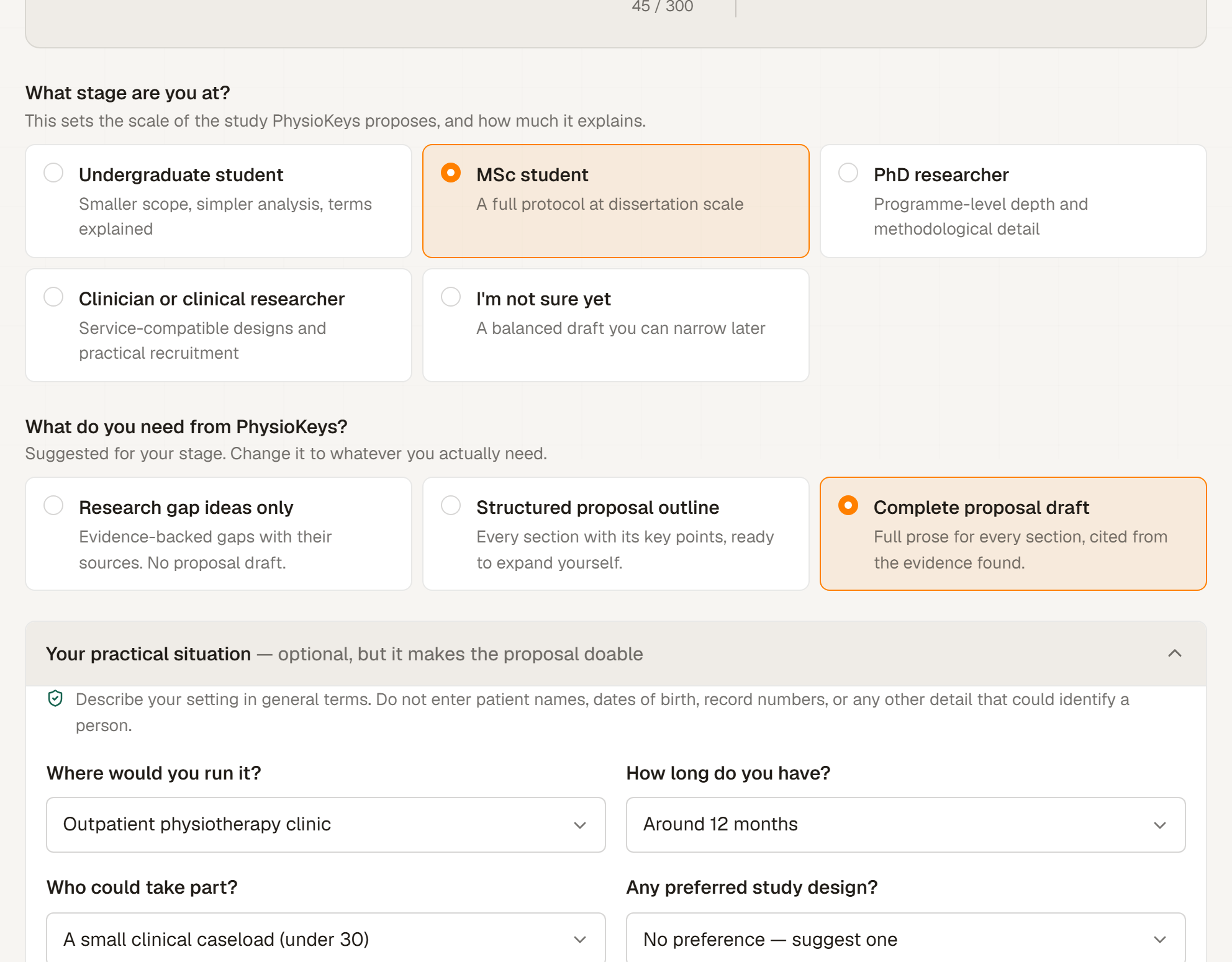
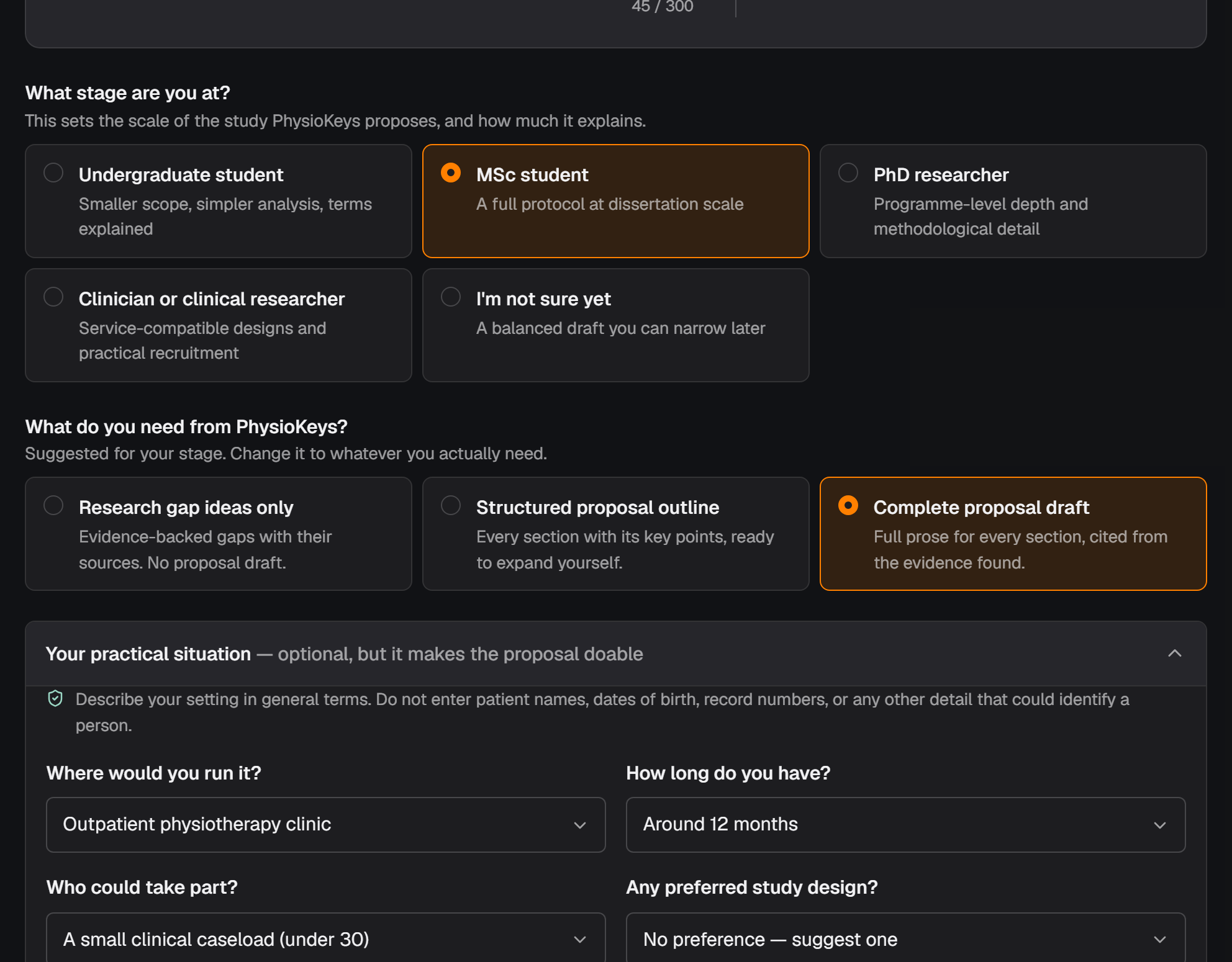
Last, how far you want it to go. You can change this later, and a project set to gap ideas only never writes — or charges for — a draft.
- Research gap ideas only
- Evidence-backed gaps with their sources. No proposal draft.
- Structured proposal outline
- Every section with its key points, ready to expand yourself.
- Complete proposal draft
- Full prose for every section, cited from the evidence found.
Opening the form searches nothing and charges nothing. You can fill in every field, read what it is about to do, and sign in at the moment you select Find research gaps — your answers are still there when you come back.
Read the gaps, and their receipts
The search takes a few minutes, and the screen names each stage as it runs: searching the library, reading the evidence, finding gaps, checking them against PubMed, then ranking what survived.
Every gap that reaches you is labelled with where it came from, and the label is a promise about the evidence behind it:
- Author-stated gap
- A study's own authors named this as an unanswered question, a limitation, or work still needed.
- AI-inferred gap
- PhysioKeys compared several studies and found a difference between them that no study has resolved. This is an inference, not something an author claimed.
- Conflicting evidence
- Two or more studies reached materially different conclusions on the same question.
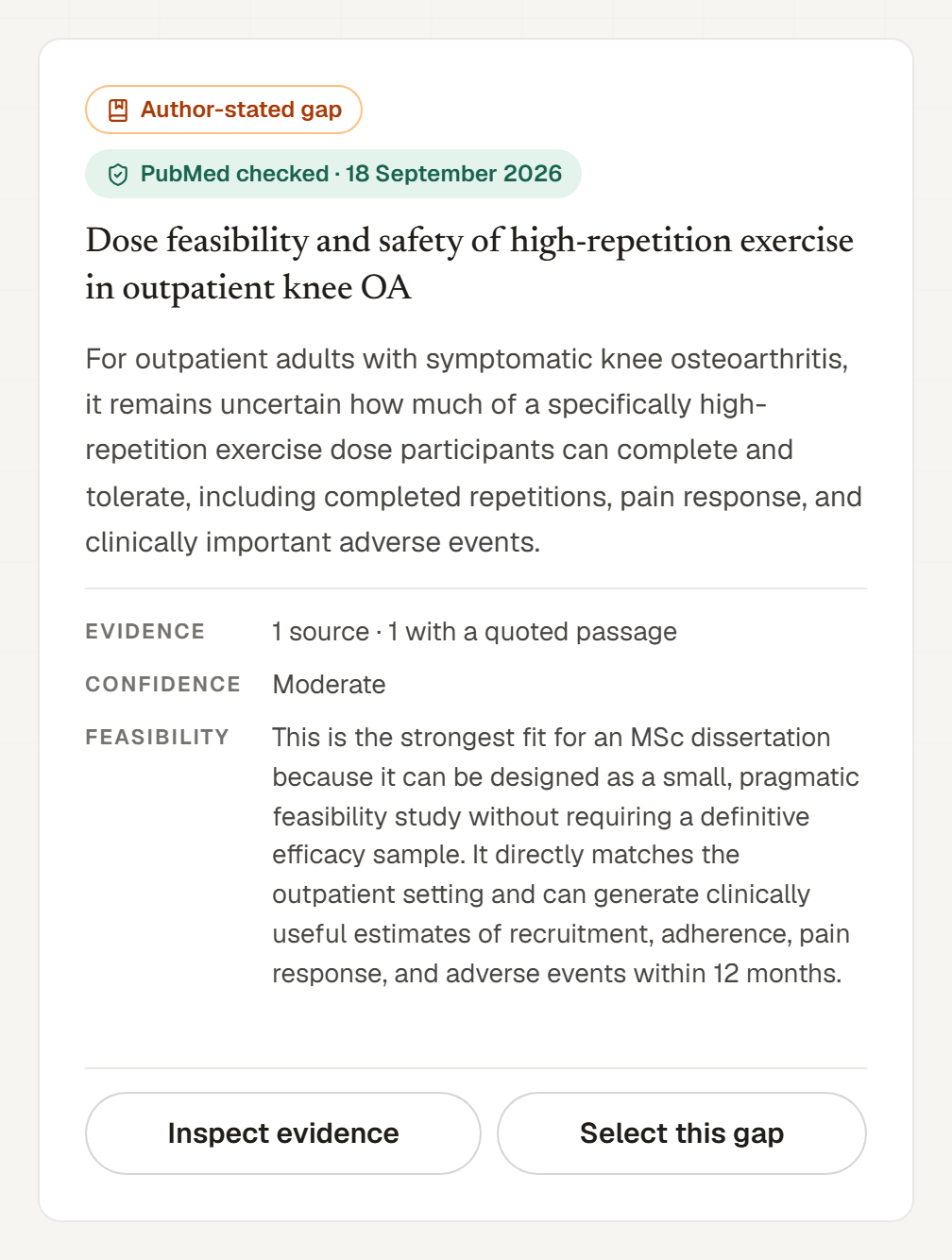
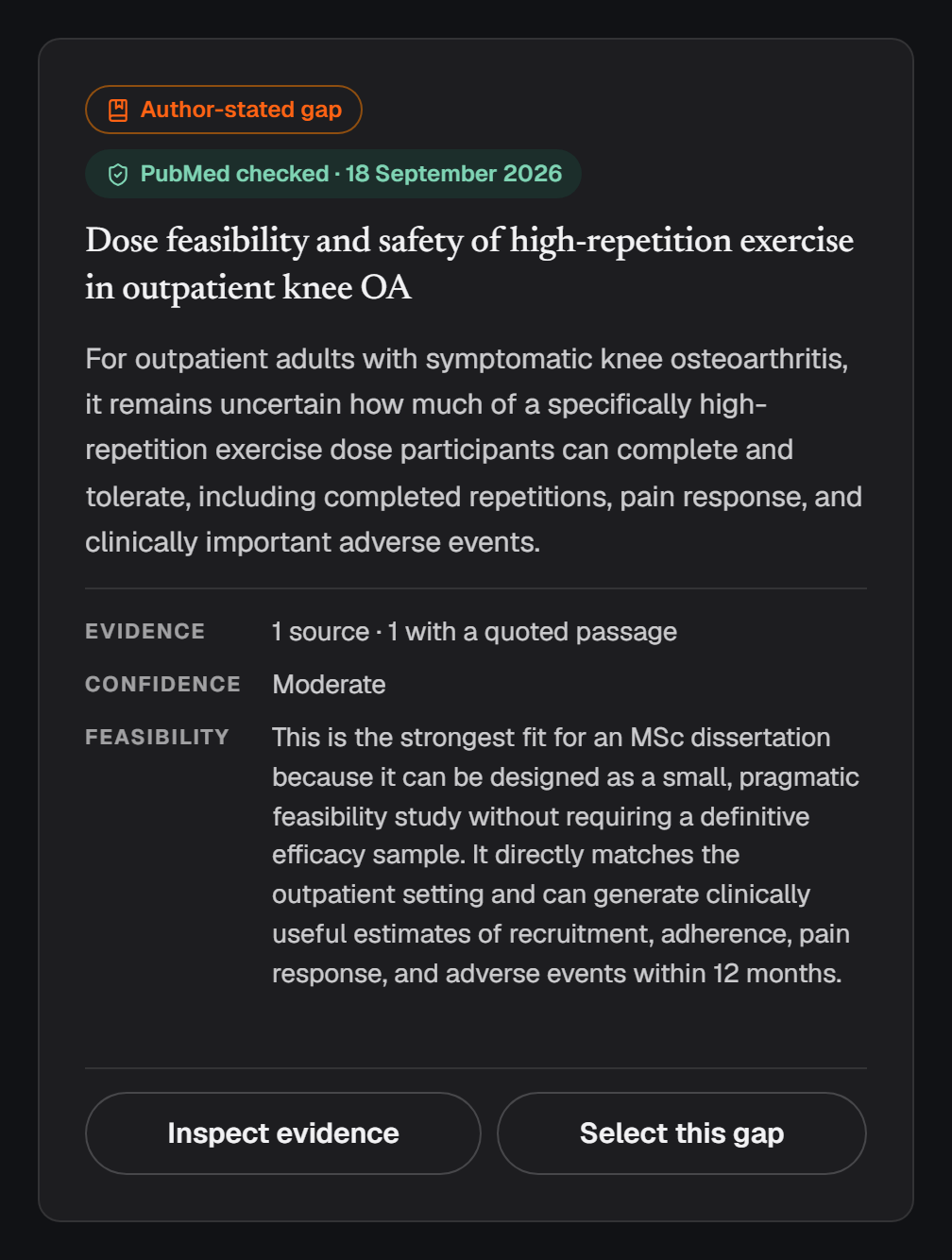
Open Evidence on a gap to see the studies it was built from, what each one contributes, and — for an author-stated gap — the passage where the authors said it. Read those before you trust a gap. A gap whose confidence reads Low is a lead to check yourself, not a finding.
Choose a gap and check the fit
Choosing a gap moves you to the fit step, which is the part most proposals skip until it is too late. It sets out what the study would take, dimension by dimension, against what you said you have, and names the hard part — the thing most likely to sink it.
If it reads as too much, go back and pick a different gap, or widen what you can reach in Setup and run the search again. That is a cheaper lesson here than in month four of a dissertation.
Generate the proposal
Generating the proposal writes it from the gap you chose and the evidence behind it: a proposed title, then each section of a proposal in the order a supervisor expects, with references drawn from the studies it used.
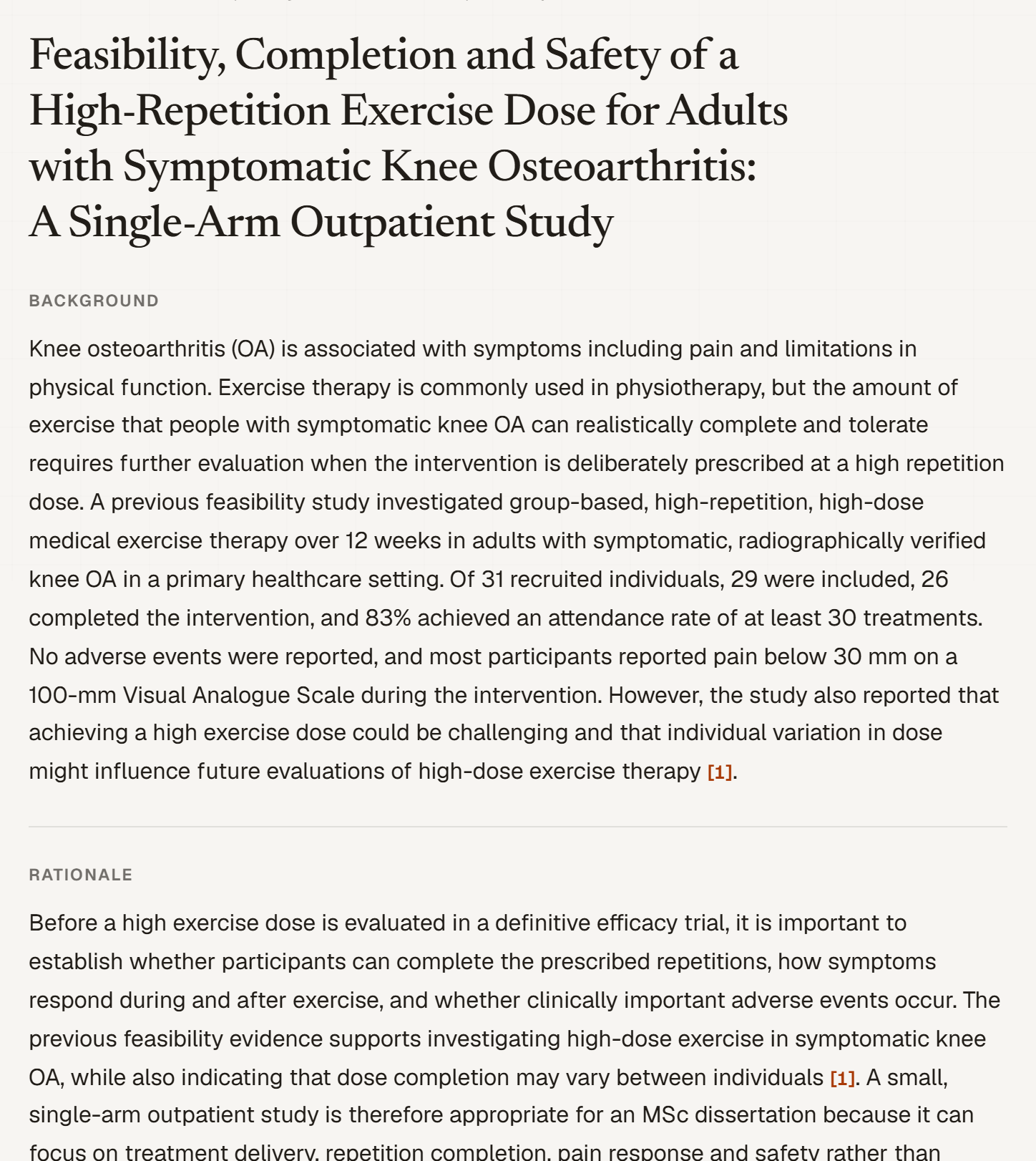
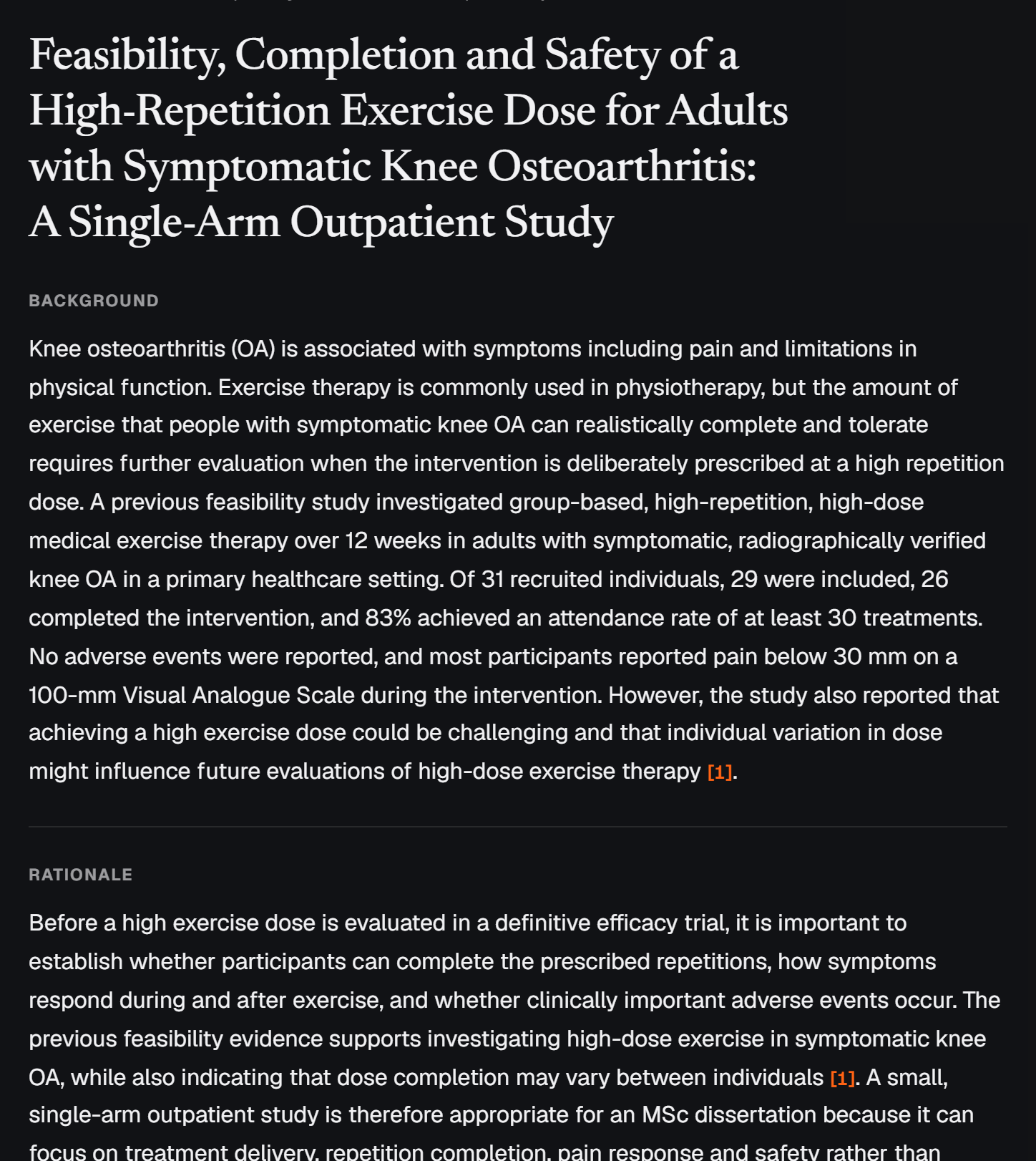
About this draft records what it was built from and the caveats that come with it. It is worth reading before you send the draft anywhere.
Keep writing in the Notebook
Select Edit in Notebook to move the draft into a note, which is where the writing actually happens: edit the text, add papers, cite as you write, and export to Word or PDF. The note keeps the proposal's references, and the builder then points at it, so there is one version rather than two.
From there the rest of PhysioKeys is useful in the ordinary way: Search for more papers to add, Chat to ask what the evidence says, and alerts to hear about new studies on your topic while you write.
What it will never tell you
The builder will not tell you that no studies exist, that something has never been researched, or that yours would be the first study of its kind. A curated library and one PubMed query cannot prove a negative, and a proposal that opens with a claim like that is a proposal a supervisor can dismantle in a sentence.
What it says instead is narrower, and checkable:
PhysioKeys found limited directly relevant evidence in the literature currently indexed in its database and no PubMed check has completed for this project yet. That reduces the risk of proposing a question that has already been answered, but it does not prove novelty: the search covers a defined set of journals and terms, and relevant work may exist outside it, be published after the check, or be indexed under different wording. Confirm the gap with your own search and with a supervisor before relying on it.
What it costs
Two steps use AI credits: the gap search costs 120, and generating the proposal costs 180. Everything else — setting up, reading the evidence, choosing a gap, the feasibility view, sending it to a note — is free.
A run that fails does not charge you: the credits go back, and a free account's allowance is only spent once a set of gaps is actually produced. On the free plan you have 1 lifetime proposal available, which is enough for one complete project. Paid plans have no project limit and use your ordinary credits. See Pricing for what each plan costs.
Common questions
How do I know if my research topic has already been studied?
Search the literature around it and look for where the answers stop rather than where they start. That is what the PhysioKeys Research Proposal Builder does for you: it reads the studies it holds on your topic, points to the questions they leave open, and runs a fresh PubMed check on each one so you can see whether anything has answered it since. It reports what it found and the date it looked, and it never claims a topic is unstudied.
How do I choose a physiotherapy dissertation topic?
Start from a clinical question you keep meeting rather than from a list, then check where the published evidence runs out on it. A topic worth a dissertation is one where studies disagree, where the authors themselves called for more work, or where nobody has tested the population, dose or setting you care about. PhysioKeys shows you those points with the studies that create them, so you can judge the topic before you commit a year to it.
Is this the same as asking ChatGPT to write a research proposal?
No. A general assistant will write a confident proposal about any gap, including one that does not exist, because nothing checks its claim. Every gap here carries the studies it came from, the passage that supports it, and a PubMed check with its date, and the builder refuses to write that no research exists on a subject.
Can I submit what it writes?
No. It is an AI-assisted first draft to think with and to take to your supervisor. Every proposal still needs your own reading, your own methods decisions, a statistician where the analysis warrants one, and ethical approval before any data is collected.
Is the Research Proposal Builder free?
The free plan includes one research proposal for the lifetime of the account, and no card is needed. Paid plans have no project limit, and AI usage follows your normal PhysioKeys credits. A run that fails costs nothing, and the free allowance is only spent once a set of gaps is successfully produced.
Can I use it for an undergraduate final-year project?
Yes. Tell it you are an undergraduate and it narrows the scope, keeps the analysis simpler and explains its terms, and the feasibility view is judged against the time, setting and participants you said you have. A project you can actually run in a few months is a better project than an ambitious one you cannot.